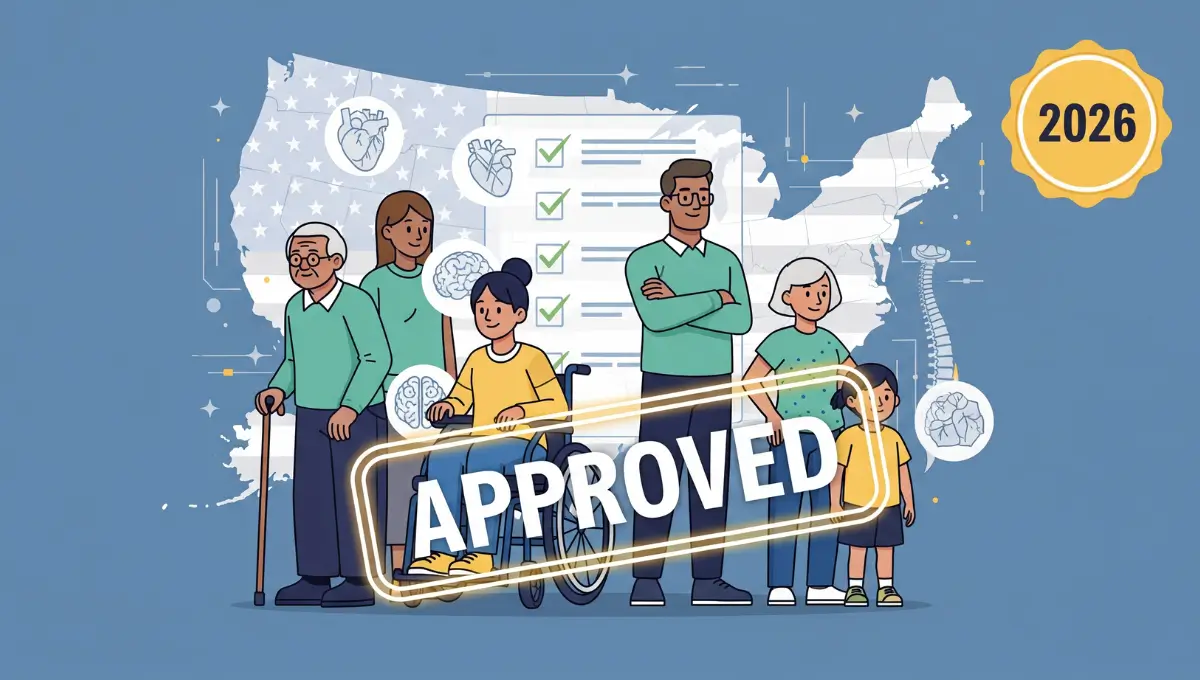
What Conditions Qualify for Disability in United States
You can qualify for disability if you have a serious medical condition that stops you from working for at least 12 months.
The Social Security Administration (SSA) reviews both physical and mental health conditions.
Your condition must be severe enough to prevent substantial work.
In 2026, you cannot earn more than $1,690 per month if working.
Quick Summary:
- Over 200 medical conditions are listed in the SSA Blue Book
- Mental health conditions like depression and PTSD qualify
- Cancer, heart disease, and chronic illnesses may qualify
- You must prove your condition lasts 12+ months
- Children and adults can both receive disability benefits
- Fast-track approval exists for 300+ severe conditions
Understanding Disability Programs in the United States
The United States offers two main disability programs through Social Security.
SSDI (Social Security Disability Insurance) is for workers who paid into Social Security. You need work credits to qualify.
SSI (Supplemental Security Income) is for people with limited income and resources. You don’t need work history for SSI.
Both programs use the same medical rules. Your condition must stop you from working for 12 months or more.
SSA Definition of Disability
The SSA has strict rules about what counts as disability.
You must meet all three requirements:
1. Cannot do substantial work You cannot earn more than $1,690 monthly in 2026. Blind individuals can earn up to $2,830 monthly.
2. Cannot do previous jobs or adjust to new work Your condition stops you from doing your old job. You also cannot learn new work because of your limitations.
3. Condition lasts 12 months or longer Your medical problem must last at least one year. It can also be a condition expected to result in death.
The SSA does not pay for short-term or partial disability.
Source: Social Security Administration – Disability Benefits
The Blue Book: Listed Medical Conditions
The SSA keeps a book called the “Blue Book.” It lists over 200 medical conditions that may qualify for disability.
Having a Blue Book condition helps your application. But you can still qualify without a listed condition if yours is equally severe.
Major Categories of Qualifying Conditions
| Body System | Common Conditions |
|---|---|
| Musculoskeletal | Severe arthritis, herniated discs, spine problems |
| Respiratory | COPD, severe asthma, cystic fibrosis |
| Cardiovascular | Heart failure, coronary artery disease, arrhythmias |
| Digestive | Chronic liver disease, inflammatory bowel disease |
| Neurological | Epilepsy, multiple sclerosis, Parkinson’s, ALS |
| Mental Health | Depression, PTSD, schizophrenia, autism, bipolar |
| Cancer | Advanced cancers, metastatic cancers, Stage 4 |
| Immune System | Lupus, HIV/AIDS, rheumatoid arthritis |
| Endocrine | Diabetes with complications like neuropathy |
Source: SSA Blue Book Adult Listings
Mental Health Conditions That Qualify
Mental health conditions are common reasons for disability approval.
The SSA evaluates mental disorders under Section 12.00 of the Blue Book.
Qualifying mental health conditions include:
- Major depressive disorder
- Generalized anxiety disorder
- Post-traumatic stress disorder (PTSD)
- Bipolar disorder
- Schizophrenia and psychotic disorders
- Autism spectrum disorder
- Intellectual disabilities
- Obsessive-compulsive disorder
- Panic disorder
- Social anxiety disorder
How the SSA evaluates mental health:
Your condition must cause extreme limitation in one area OR marked limitation in two areas:
- Understanding and remembering information
- Interacting with other people
- Concentrating on tasks
- Managing yourself and adapting to change
You need strong medical evidence. This includes therapy notes, psychological testing, medication records, and doctor statements.
Physical Conditions That Qualify
Many physical conditions qualify if they prevent work.
Common qualifying physical conditions:
Heart and circulatory:
- Chronic heart failure
- Coronary artery disease
- Peripheral artery disease
- Recurrent arrhythmias
Lung and breathing:
- Chronic obstructive pulmonary disease (COPD)
- Pulmonary fibrosis
- Severe asthma requiring frequent hospitalization
Spine and joints:
- Herniated discs with nerve damage
- Severe arthritis limiting mobility
- Spinal stenosis
- Degenerative disc disease
Neurological:
- Multiple sclerosis
- Parkinson’s disease
- Epilepsy with frequent seizures
- Cerebral palsy
- ALS (Lou Gehrig’s disease)
Cancer:
- Any Stage 4 cancer
- Pancreatic cancer
- Liver cancer
- Esophageal cancer
- Leukemia or lymphoma
Kidney disease:
- Chronic kidney disease requiring dialysis
Meeting vs. Equaling a Listing
Your condition doesn’t need to exactly match the Blue Book.
Meeting a listing means your medical records match the exact criteria. This includes specific test results and documented limitations.
Equaling a listing means your condition is just as severe. For example, fibromyalgia is not in the Blue Book. But it can equal a listing if severe enough.
Many people qualify by proving their condition equals a listed one.
Non-Medical Requirements for Disability
Medical conditions alone don’t guarantee approval. You must also meet work and financial rules.
SSDI Work Credit Requirements
SSDI requires work history. You earn credits by working and paying Social Security taxes.
In 2026, you earn one credit for every $1,890 in wages. You can earn up to four credits per year.
Credits needed by age:
| Your Age | Credits Needed | Years of Work |
|---|---|---|
| Under 24 | 6 credits | 1.5 years |
| 24-30 | Variable | Half the time since age 21 |
| 31 or older | 20-40 credits | 5-10 years |
| 50+ | 28 credits | 7 years |
Generally, you need 40 total credits. At least 20 must be from the last 10 years.
SSI Financial Requirements
SSI has no work requirement. But you must have limited income and resources.
2026 SSI limits:
- Maximum income: $994/month for individuals, $1,491 for couples
- Maximum resources: $2,000 for individuals, $3,000 for couples
- Cannot earn over $1,690/month from work
Resources include bank accounts, stocks, and property (excluding your home).
Source: SSA SSI Payment Amounts
The 5-Step Disability Evaluation Process
The SSA uses five steps to decide if you qualify.
Step 1: Are you working? If you earn over $1,690 monthly, you usually won’t qualify.
Step 2: Is your condition severe? Your condition must significantly limit basic work activities. This includes walking, sitting, lifting, or remembering.
Step 3: Does it meet or equal a Blue Book listing? If yes, you’re usually approved. If no, move to step 4.
Step 4: Can you do your past work? The SSA looks at jobs you did in the last 15 years. If you can still do any of them, you’re denied.
Step 5: Can you do any other work? The SSA considers your age, education, skills, and physical limits. If no jobs exist that you can do, you’re approved.
Most approvals happen at step 3 or step 5.
Compassionate Allowances Program
Some conditions qualify for fast-track approval. This is called Compassionate Allowances (CAL).
Over 300 conditions qualify for CAL. These are the most severe medical problems.
CAL processing time: 15-20 days instead of 3-5 months.
Common CAL conditions:
- ALS (Lou Gehrig’s disease)
- Pancreatic cancer
- Acute leukemia
- Early-onset Alzheimer’s disease
- Small cell lung cancer
- Stage 4 cancers
You don’t need a separate application. Just mention your CAL condition when applying.
Source: National Council on Aging – Compassionate Allowances
Disability Benefits for Children
Children under 18 can receive SSI disability benefits.
A child qualifies if they have a condition causing “marked and severe functional limitations.” The condition must last 12 months or more.
Common childhood conditions:
- Autism spectrum disorder
- Cerebral palsy
- Intellectual disabilities
- Down syndrome
- Severe ADHD
- Childhood cancer
- Cystic fibrosis
The family must also meet SSI income and resource limits. Parent income counts when determining eligibility.
Special Rules for Blind Individuals
Blind people have more favorable rules.
Benefits for blind applicants:
- Higher work limit: $2,830/month (instead of $1,690)
- No work limit for SSI blind recipients
- Faster approval process
- Can keep benefits while working
You qualify as blind if:
- Central visual acuity of 20/200 or less with correction
- Or visual field limitation to 20 degrees or less
Partial vision loss may also qualify when combined with other conditions.
2026 ABLE Account Expansion
Starting January 1, 2026, more people can open ABLE savings accounts.
New rule: Disability must start before age 46 (up from age 26).
Why ABLE accounts matter:
- Save up to $18,000 yearly without losing benefits
- First $100,000 doesn’t affect SSI eligibility
- Tax-free growth on savings
- Can save for education, housing, transportation, and healthcare
About 14 million more Americans now qualify. This includes people with disabilities that began in adulthood.
Source: ABLE National Resource Center
How to Apply for Disability Benefits
You can apply three ways:
1. Online at ssa.gov Available 24/7 for SSDI applications (ages 18-65).
2. By phone: 1-800-772-1213 Monday-Friday, 7 a.m. – 7 p.m. Eastern time.
3. In person at your local Social Security office Find your office at ssa.gov/locator.
What documents you need:
- Birth certificate or proof of age
- Medical records and doctor contact information
- List of medications
- Work history for the past 15 years
- Lab results and test reports
- Hospital and clinic records
Strong medical evidence is key. The more documentation you provide, the better your chances.
Source: SSA Disability Application
2026 Disability Payment Amounts
SSDI average benefit: $1,580 per month
SSI maximum benefit (2026):
- Individuals: $994/month
- Couples: $1,491/month
Both programs received a 2.8% cost-of-living increase in January 2026.
SSDI amounts depend on your past earnings. SSI pays a flat rate based on need.
Frequently Asked Questions
What are the top 5 conditions that qualify for disability?
The most common are:
1) musculoskeletal problems like back pain,
2) mental health disorders including depression,
3) cardiovascular disease,
4) cancer, and
5) neurological conditions.
Any severe condition preventing work for 12+ months may qualify.
Can I work while receiving disability benefits in 2026?
Yes, through special programs. SSDI offers a 9-month trial work period. SSI allows limited income. You must stay under $1,690/month for non-blind individuals or $2,830/month for blind individuals to maintain full benefits.
How long does it take to get approved for disability?
Most applications take 3-5 months. Compassionate Allowances cases can be approved in 15-20 days. If denied, appeals can take 12-24 months.
Do mental health conditions really qualify for disability?
Yes. Depression, PTSD, anxiety, bipolar disorder, and schizophrenia commonly qualify. You need proof your condition causes extreme or marked functional limitations in daily activities.
What happens if my condition isn’t in the Blue Book?
You can still qualify by showing your condition equals a listed one in severity. Many people with fibromyalgia, chronic fatigue, or rare diseases qualify this way.
Can I get both SSDI and SSI at the same time?
Yes. This is called “concurrent benefits.” If your SSDI payment is low, you may receive SSI to bring your total income up to the SSI limit of $994/month.